 Vineeth K Kolarath
Think about the last time you got something wrong in front of other people.
An answer in class. A calculation on the board. A question in an interview.
Perhaps you felt your face go warm. Perhaps you wished you could take the moment back. Maybe you decided that it would be safer not to volunteer next time.
Most of us know that feeling.
Somewhere along the way, many of us begin to treat mistakes as things to hide. We worry less about understanding what went wrong and more about making sure nobody notices.
I would like to suggest a different way of looking at them.
In engineering, a mistake can be useful information. It tells us that something did not happen as expected. If we examine it carefully, it may help us understand why.
That is where learning begins.
What a mistake actually tells you
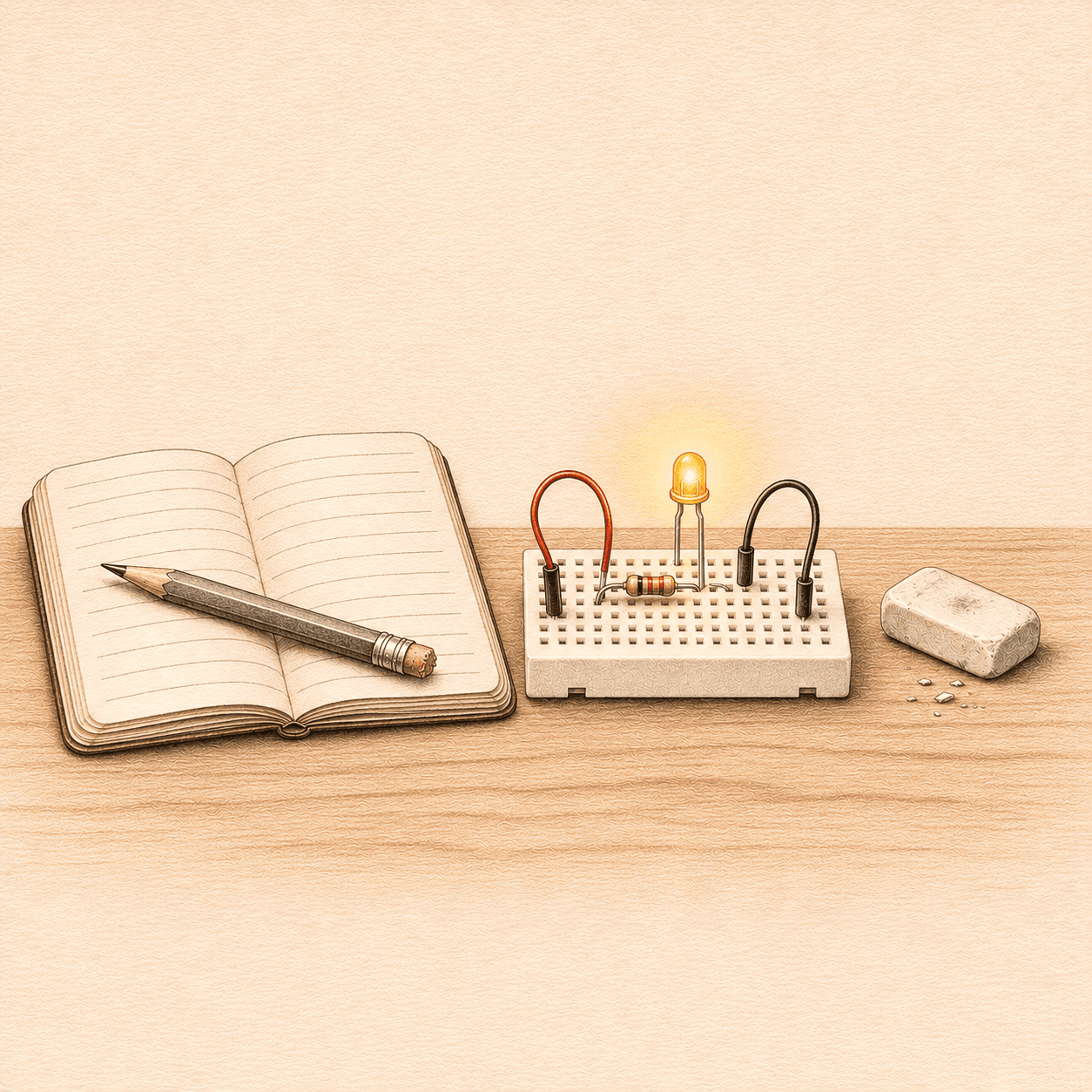
Imagine that you have built a small electronic circuit, but the LED does not light up.
You could say, "It doesn't work," put it aside and move on.
Or you could start asking questions.
Is the power reaching the board? Is the LED connected in the right direction? Is the resistor correct? Is the connection loose? Is the code sending the right signal?
You check one thing at a time. Each check helps narrow down the possibilities. Eventually, you find the problem.
This is part of what engineers call debugging.
The important thing is not that the circuit failed. It is that you now have a better understanding of what happened and what needs to change.
The same approach can help a student.
A wrong answer in an examination can be frustrating. But instead of simply looking at the mark, look at the working.
Did you forget a formula? Did you misunderstand the question? Was there a calculation error? Did you know the method but apply it in the wrong situation?
The answer alone may not tell you everything. The steps you took to reach it often tell you much more.
That is why I like the phrase "mistakes are data."
A mistake is not automatically useful. But it can become useful information when we take the time to understand it.
Machines learn from errors too
There is an interesting connection between this idea and machine learning.
In How a Machine Learns from Examples, I described how a machine can learn from examples.
Consider a simple supervised learning system.
It receives an example and makes a prediction. During training, that prediction is compared with the expected answer. A mathematical measure called a loss function tells the system how far its prediction was from the target. The training process then adjusts the model's internal parameters to improve its predictions.
This happens across many examples.
The process is more complicated than simply making a guess and correcting it, but the basic idea is easy to understand: the difference between a prediction and the expected result helps guide learning.
Of course, not every kind of machine learning works this way. But it is a useful example of how information about errors can help a system improve.
There is something worth thinking about here.
We build machines that can learn from imperfect predictions. Yet many of us expect ourselves to learn without ever getting anything wrong.
Perhaps we should be a little more patient with ourselves.
Systems that learn from what went wrong
Some of the world's most demanding engineering systems have ways of examining failures and using the findings to improve safety.
Aviation is one example.
When an aircraft accident or serious incident occurs, specialised investigators examine what happened, why it happened and what can be done to reduce the chance of a similar event.
The purpose of a formal aviation safety investigation is to prevent future accidents, not to assign blame or legal responsibility. India's Aircraft Accident Investigation Bureau states this as the objective of its investigations.
This does not mean that mistakes have no consequences or that accountability is unimportant. It means that understanding the causes of an accident is essential if safety is to improve.
Closer to home, India's space programme offers another example.
In September 2019, the Vikram lander of Chandrayaan-2 experienced problems during its final descent and made a hard landing on the Moon.
It was a difficult moment for the team and for the country. The mission's landing attempt had not succeeded.
But the work did not stop there.
When ISRO developed Chandrayaan-3, it incorporated lessons from the earlier mission. The lander was modified to handle a wider range of possible variations. Improvements were made to sensors, software, propulsion and other systems. Redundancies, simulations and additional tests were also part of the effort.
On 23-08-2023, Chandrayaan-3 successfully completed its soft landing in the lunar south polar region.
I do not want to reduce such an achievement to a simple story of failure followed by success. A mission of this scale depends on the work of many people, years of preparation and countless engineering decisions.
But one thing is clear: the experience of Chandrayaan-2 informed the design and testing of Chandrayaan-3.
A setback became part of the knowledge that helped the next mission.
That is an attitude worth learning from.
Not every mistake is the same
If we want to learn from mistakes, we need to understand what kind of mistake we have made.
There is no single classification that covers every situation, but the following categories can be a useful starting point.
A careless slip.
You knew the method, but copied a number incorrectly, missed a negative sign or made a small calculation error.
The solution may be to slow down, organise your working and develop a habit of checking your answer.
A gap in knowledge.
You did not know a fact, formula or definition needed to solve the problem.
The next step is to go back and learn it. There is no shortcut around knowledge.
A misunderstanding.
You thought you understood an idea, but your understanding was incomplete or incorrect.
This needs more attention. You may have to revisit the concept, find another explanation and work through a few examples until the idea becomes clear.
A wrong approach.
You knew the relevant methods but chose one that did not suit the problem.
Here, the important question is not just how to use a method, but when to use it.
A misread question.
You answered a different question from the one that was actually asked.
Try reading it again and explaining in your own words what it wants you to find.
A difficult circumstance.
You were tired, distracted, unwell or working under unusual pressure.
Not every mistake points to a gap in knowledge. Sometimes the circumstances matter too.
The point of this exercise is not to find a label for every error. It is to move beyond saying, "I got it wrong," and begin asking, "Why did I get it wrong?"
That is a much more useful starting point.
Separate the mistake from yourself
This is perhaps the hardest part.
"I made a mistake" and "I am a failure" may sound close, but they are very different statements.
The first describes something that happened.
The second turns that moment into a judgement about who you are.
When a mistake feels like a judgement on your ability, it is natural to protect yourself. You may stop asking questions, avoid difficult problems or hide your working because you do not want anyone to see where you struggled.
But when you separate the mistake from your identity, you can look at it more calmly.
You can ask what happened. You can accept that something needs improvement. And you can decide what to try next.
This does not mean mistakes never matter.
Some mistakes have serious consequences. A wrong medicine dose or an incorrect bridge calculation can put lives at risk. That is why professionals use careful procedures, independent checks and safeguards.
Taking mistakes seriously is not the same as being afraid of them.
It means recognising their consequences, learning from them and doing what is necessary to prevent them from happening again.
Start small, and mistakes cost less
This is one reason I keep suggesting that beginners start with small projects.
In Why Your First Project Should Be Small, I wrote about how a small project gives you a chance to finish something, see what went wrong and try again.
Imagine building a simple LED circuit before attempting a complicated electronic system.
If the small circuit does not work, there are only a few things to investigate. You can understand each connection and test one change at a time.
With a much larger project, several things may go wrong together. Finding the cause becomes harder.
Small projects do not eliminate mistakes. They make it easier to understand them.
The same applies to learning almost anything.
Take a small piece. Try it. Notice what happens. If it does not work, look at why. Then try again.
Reading and watching explanations are useful, but there is something different about attempting a task yourself and discovering where your understanding needs work.
Just remember that small projects still need sensible safety precautions, particularly when electricity, tools or other risks are involved.
Why asking questions helps
Mistakes and questions belong together.
In Good Questions Matter More Now, I wrote about how a good question helps reveal what you already understand and where you are stuck.
A mistake can point us towards that same place.
After getting something wrong, instead of asking, "Why am I so bad at this?", try asking:
"Where did my thinking go off track?"
"What did I assume that was not true?"
"Which part should I understand better?"
"Can I solve a similar problem now?"
These questions do not make the mistake disappear. They help turn it into something you can work with.
The first kind of question makes the mistake feel like a judgement.
The others help you find a way forward.
A word to parents and teachers
Young people notice how adults react to mistakes, including their own.
If a wrong answer in class is met with a sigh or a laugh, students may become reluctant to speak. They begin to worry more about embarrassment than about understanding.
But imagine a different response.
A student gives an incorrect answer, and the teacher says, "Thank you for trying. Let's look at how you reached that answer."
That simple response creates an opportunity to understand the student's thinking. It may also help other students who had the same doubt.
At home, the same approach can make a difference.
When a child brings home a disappointing result, the first response need not be a lecture. Try asking:
"What did you find difficult?"
"Which questions surprised you?"
"What would you do differently next time?"
Marks matter. They tell us something about performance at a particular point in time. But they do not tell the whole story of what a student understands or how capable that student can become.
It also helps when adults admit their own mistakes.
A teacher who says, "I got that wrong yesterday. Let me show you where," is demonstrating that learning does not stop when someone becomes an adult.
We should not expect children to be comfortable admitting mistakes if we are unwilling to do the same.
Try this
For two weeks, keep a small mistake log.
Take any notebook. Each time you get something wrong, whether in a test, an exercise, a project or even a small everyday task, write down four things:
- What happened?
- What kind of mistake was it?
- What do I think caused it?
- What will I try differently next time?
Keep each entry short. You are not writing an essay about every mistake. A few honest lines are enough.
At the end of two weeks, read the log from the beginning.
Look for patterns.
Do you often misread questions? Does the same topic keep appearing? Are you making calculation errors that a final check could catch? Do you understand an idea when someone explains it, but struggle to apply it yourself?
Choose one pattern and work on it for a week. Only one.
You may discover that some of your mistakes are not random. They point towards a particular habit, topic or step in your thinking that needs attention.
That is useful information.
In my first essay, Bring a Rough Idea, I asked you to bring a rough idea.
This time, bring your mistake log.
Do not use it to judge yourself. Use it to understand yourself a little better.
A mistake does not have to be the end of an attempt. Sometimes, it is the beginning of understanding what to do next.